

Philippines Ferry & Transport Guide: How to get Between Islands Without the Stress
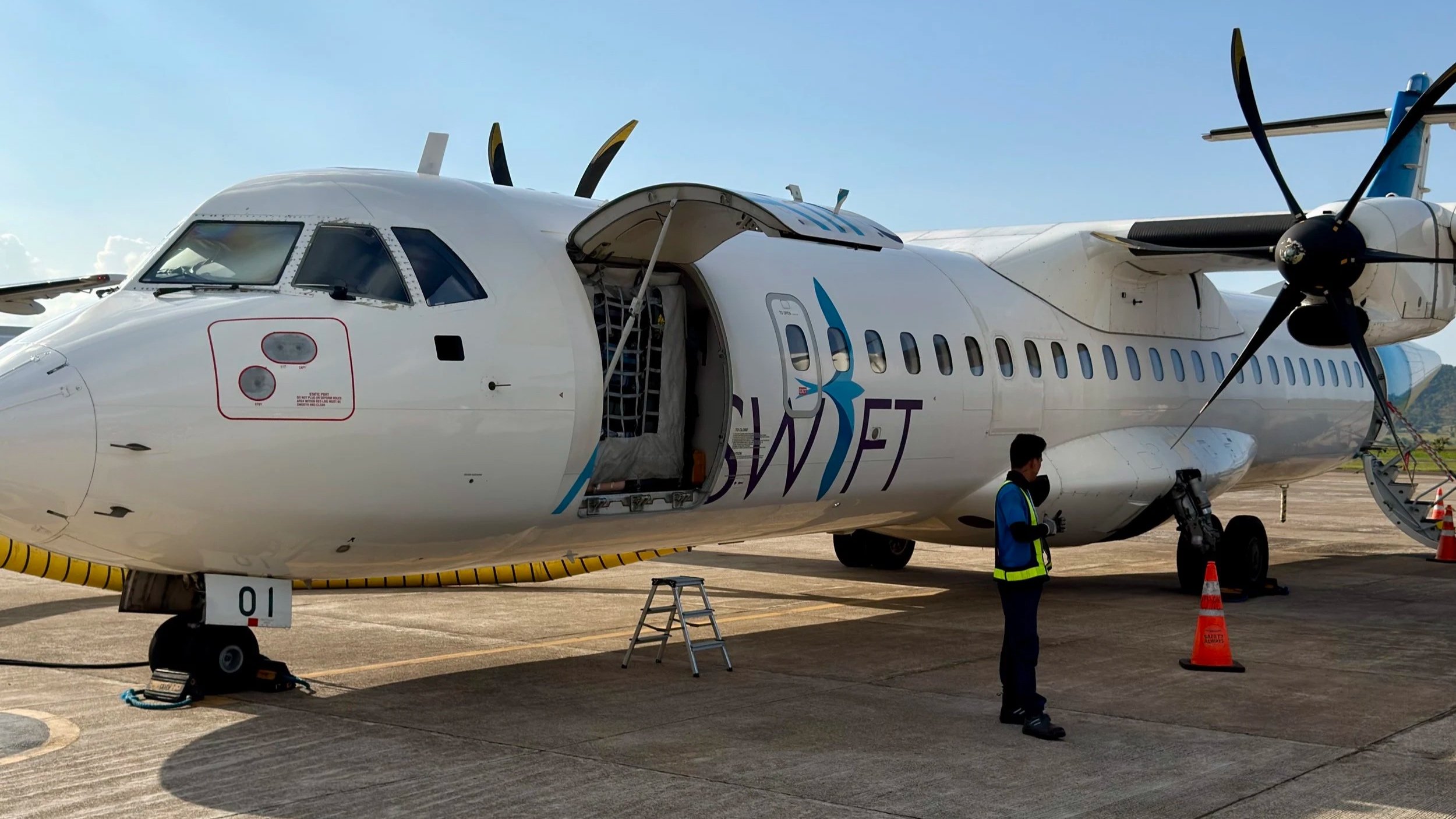
Our plane from Coron to Clark (Manila)
The one part of Philippines travel that trips up first-timers, explained connection by connection from our own trip, including the fees nobody warns you about.
We travelled the Philippines in March 2026 in this order: Siquijor, Bohol, Balabac, El Nido, Coron. Our full Philippines itinerary
We assumed the ferries would be the easy part. Then we stood on a dock in Dumaguete watching the departure board change three times in twenty minutes, and realised transport here works on its own logic. Once we understood that logic, island hopping the Philippines stopped feeling like guesswork.
This guide is the practical companion to our full route. It covers every way you'll move between islands: ferries, domestic flights, vans, tricycles and boats. Every connection here is one we actually took, with the real prices, the real timings and the traps we walked into so you don't have to.
If you want the day-by-day of each destination, those live in the individual guides linked at the bottom. This one is purely about getting from A to B.
The Four Ways You'll Move Around
The Philippines is an archipelago of more than 7,000 islands. Every longer journey comes down to four options, and knowing which to use when saves you both time and money:
- Domestic flights: for long distances between major hubs (Manila, Cebu, Dumaguete, Puerto Princesa). Fast, affordable, frequent.
- Fast ferries: for island-to-island hops, mainly through the Visayas and around Palawan. Comfortable when you pick the right operator.
- Vans and buses: for overland stretches, especially in Palawan (Puerto Princesa to El Nido, or down to Balabac).
- Tricycles and tuk-tuks: for the last mile, from port or airport to your hotel.
The skill isn't using one of these. It's combining them without losing a day. Here's how.
Booking Ferries: Start with 12Go Asia
Nearly every ferry on our trip was booked through the same platform, and we'd recommend it without hesitation: 12Go Asia
Why it became our default:
- It shows all available crossings and operators for a route in one place, so you can compare times and boat types at a glance
- You book in advance and skip the risk of a sold-out counter, ferries do fill up on popular routes
- Your ticket arrives as a PDF you keep on your phone
One thing that surprised us in a good way: we booked our El Nido to Coron ferry in November for a late-March crossing and received the actual ticket about a month before departure. If your ticket doesn't arrive immediately, that's normal here, don't panic.
Book the boat, then read the next part before you show up at the port, because the ticket price is only part of what you'll pay.
The Port Fees Nobody Warns You About
This is the detail that catches first-timers off guard. Beyond your ticket, most ferry crossings add small fees at the port itself, payable in cash. They're minor individually, but they add up and you'll want the right change.
On our crossing out of Dumaguete we paid, on top of the ticket:
- A 50 peso ecological fee per person
- A 14 peso port fee
- 145 pesos for two backpacks (luggage is charged separately)
On the Siquijor leg it was a 15 peso port fee per person plus 30 pesos for one piece of luggage. The exact amounts vary by port, but the pattern is the same everywhere: expect a terminal fee, sometimes an environmental fee, and a separate luggage charge.
Keep small bills handy for exactly this. Standing at a counter unable to break a 1,000 peso note while your ferry boards is a stress you can skip.
Fees sorted. Now the part that decides whether your crossing is a pleasure or an ordeal: which boat you're on.
Fast Ferry vs Public Ferry: The Decision That Matters Most
The single most useful thing we learned about Philippine ferries: on routes where you have a choice, the boat you pick matters more than almost anything else.
Take our El Nido to Coron crossing as the clearest example. This route has a poor reputation online, and we nearly let the reviews scare us off. Here's what we discovered: almost all the bad reviews are about the public ferry. It's cheaper, but it takes longer, runs late more often, and offers a very different standard.
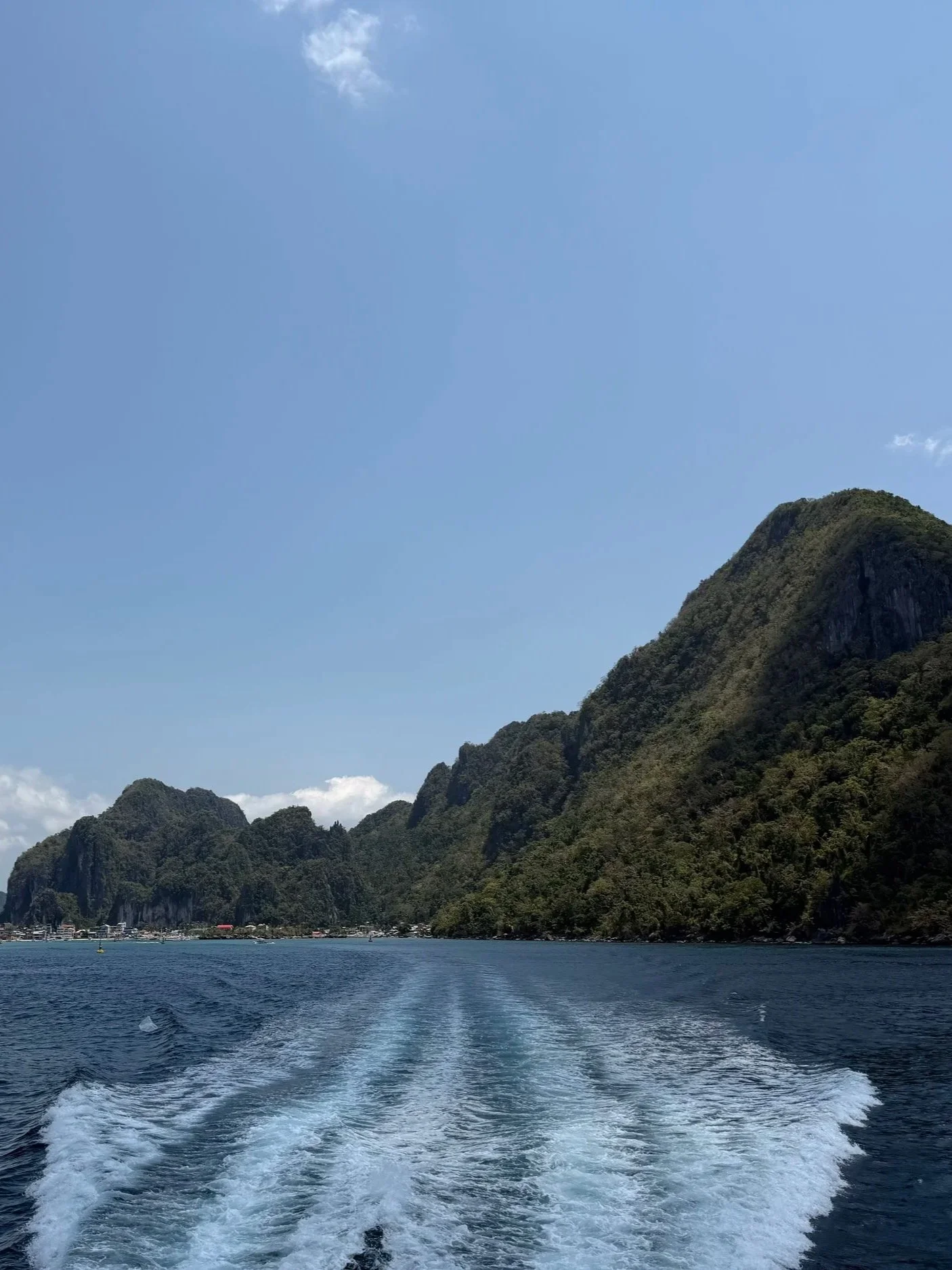
We booked the Jomalia fast ferry instead, and it was one of the most comfortable four hours of the whole trip:
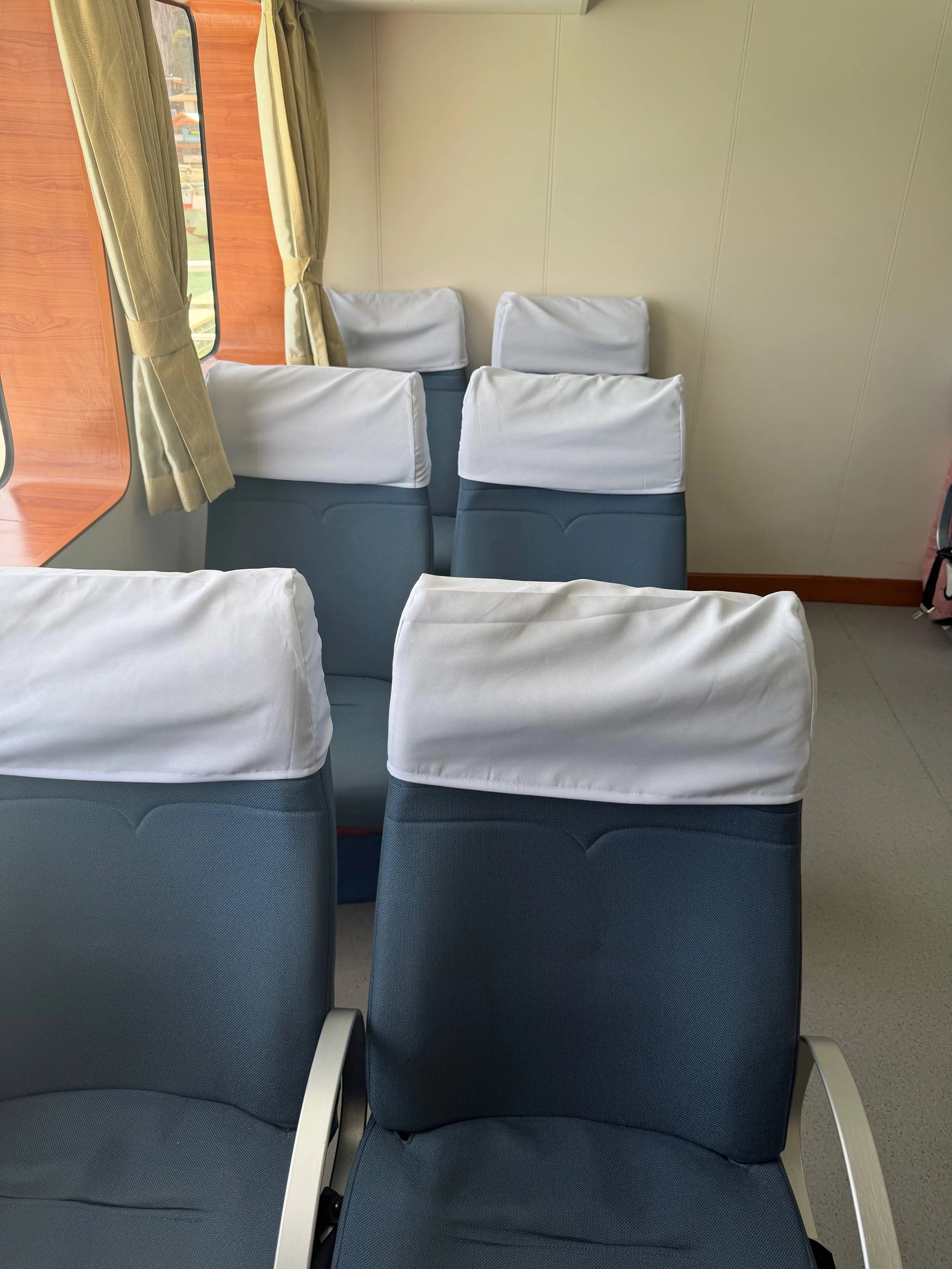
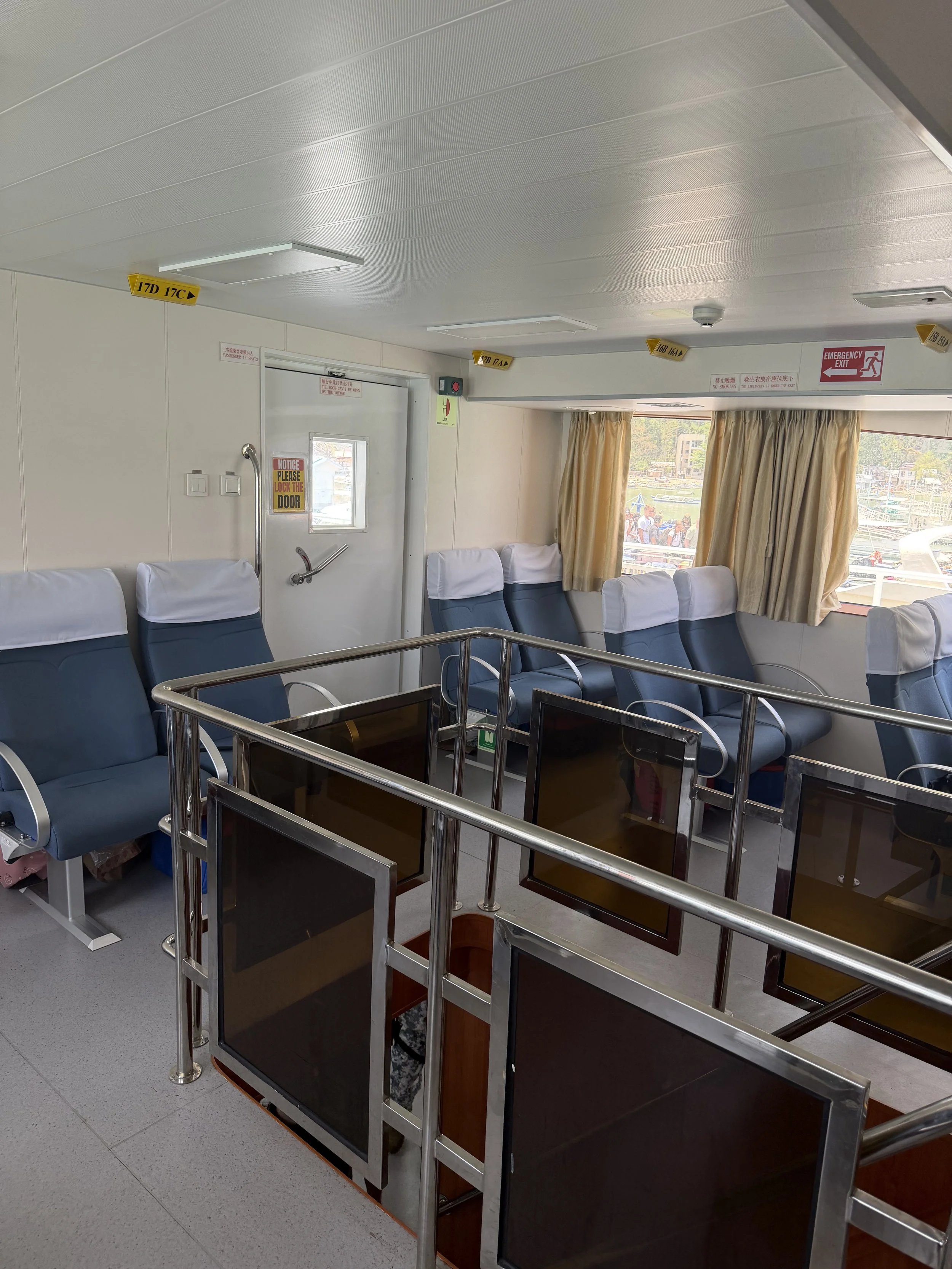
- Air conditioning throughout, spotlessly clean, seats large and properly comfortable
- A choice of lower deck, upper deck or outside seating
- A well-stocked bar on board with soups, snacks, sandwiches and drinks
- Our tickets showed seat numbers, but boarding was free seating, so we grabbed the front of the upper deck with more legroom than most flights
Two practical notes for this boat: the PDF on your phone is fine, staff simply photograph it at the entrance, and after the security check you can wait in an air-conditioned room rather than outside. One warning: it gets seriously cold on board, so bring a layer or plan to step outside now and then.
The lesson generalises: whenever a route offers both a fast ferry and a public ferry, the fast one is usually worth the extra pesos. Check the operator on 12Go before you book on price alone.
On the Visayas routes, OceanJet is the largest operator and usually the safer bet when you have a choice.
Ferry or Flight? When Each One Wins
For some legs you can choose between a ferry and a short domestic flight. Our rule of thumb, from doing both:
Fly when the distance is long and connects major hubs. Domestic flights across the country (Manila, Cebu, Dumaguete, Puerto Princesa) are affordable and frequent, and save you a full day compared to boats. We used four domestic flights to cover the big distances.
Take the ferry when the islands are close and the fast boat exists. The El Nido to Coron fast ferry is the perfect case: the flight is quicker in the air, but you'll drive 30 to 40 minutes to the airport first and pay upwards of €200 for two, while the ferry costs a fraction of that and, on the Jomalia, doesn't feel like a compromise at all.
For booking domestic flights, one tip from our trip: AirAsia Move came in consistently cheaper than the usual comparison sites on several legs, worth checking alongside Skyscanner.
Speaking of flights, one of them nearly derailed our entire trip, and it's worth knowing why.
A Word on Timing and World Events
One week before departure, the conflict between the USA and Iran closed the airspace over Bahrain, Qatar, Abu Dhabi and Dubai. Our original international flights were cancelled and, to their credit, fully refunded. We rebooked last minute for far more than we'd planned.
We mention it not to alarm you but as a genuine planning lesson: build a financial buffer into any long-haul trip. Weather, politics and mechanical issues can all reshape your plans a week before you fly. Travel insurance and a little slack in the budget aren't luxuries on a trip this far from home.
That buffer thinking applies to your day-to-day connections too, which brings us to the overland stretches.
Overland in Palawan: The Van Journeys
Two of the most demanding transport legs of our trip weren't on water at all. They were the van rides in Palawan.
Puerto Princesa to El Nido
A small van (around 9 seats) picked us up directly, arranged through our hotel in Puerto Princesa, for the 4 to 5 hour ride north, with one break along the way. Straightforward to book, straightforward to ride.
Puerto Princesa to Balabac
This is the tough one, and you should know what you're signing up for:
- 2:45am pickup from your resort in Puerto Princesa
- 4 to 5 hours by van heading south, with one stop for breakfast and toilets
- Then a 1 to 1.5 hour boat crossing on a local outrigger to reach the camp
The honest part: the van ride is rough, and in the back rows you feel every pothole. Sleeping back there is close to impossible. The drivers know the road and brake before the bigger bumps, but if you get any choice of seat, sit closer to the front. Your spine will thank you around hour three.
Both these journeys are usually arranged for you, through your hotel or as part of a tour package. You rarely need to organise Palawan overland transport independently, and given the early starts and remote roads, that's a relief.
Once you're on the islands, getting around gets much simpler, and often more fun.
On the Islands: Scooters, Tricycles and Tuk-Tuks
Scooters were our default on every island where the spots were spread out, Siquijor, Bohol, El Nido. The going rate was a consistent 500 pesos per day, and our tip stands everywhere: rent from your accommodation rather than a random shop. Hosts lend you a bike they trust, and if something's wrong, the fix is one conversation at the front desk instead of a breakdown across the island.
Tricycles and tuk-tuks handle the short hops, especially from port or airport to your hotel. A few real fares from our trip for reference:
- Coron port to hotel by tuk-tuk: 400 pesos
- Bohol pier transfer arranged in advance: driver waiting, no searching with bags
- Siquijor port transfer through our resort: 850 pesos, booked ahead so a driver met the ferry
- Bohol to Panglao Airport, arranged through the hotel: 1,200 pesos
The pattern worth copying: arrange your port or airport transfer through your accommodation in advance wherever you can. After a long travel day, having someone waiting with your name instead of negotiating with backpacks on is worth every peso.
One more transport surprise waited for us at the very end of the trip.
Leaving Coron: The AirSwift Clark Trap
This one cost other travellers real stress, so we're flagging it clearly: AirSwift no longer flies Coron to Manila. It flies to Clark. We found this out at the airport.
Clark is a modern, pleasant, nearly empty airport, but it is not Manila, and it's a couple of hours away. If you're connecting to an international flight out of Manila, check your arrival airport carefully when booking.
The fix if you land at Clark: the Genesis Bus runs several times daily from Clark to Manila's Terminals 1, 2 and 3. It takes 2 to 2.5 hours and costs 450 pesos per person including luggage. For comparison, a taxi quoted us 6,500 pesos for the same route. Take the bus.
One Date to Check Before You Book Anything: Holy Week
A timing warning that affects transport, shops and daily life alike: during Holy Week, specifically Maundy Thursday and Good Friday, much of the Philippines closes down. We arrived in Manila on Maundy Thursday expecting a final shopping day and found even the malls shut.
If your trip overlaps with Holy Week (the dates move each year, so check), plan those two days deliberately. Ferries and flights can be busier and some services pause. It's a culturally beautiful time, just not one for errands or tight connections.
Quick Reference: Every Connection From Our Trip
- Manila → Dumaguete: domestic flight (Philippine Airlines), then tricycle to the port
- Dumaguete → Siquijor: fast ferry via 12Go (OceanJet), plus port and luggage fees
- Siquijor → Bohol: ferry via 12Go (expect ~30 min delays, build in slack)
- Bohol → Panglao Airport: private driver, 1,200 pesos
- Bohol → Puerto Princesa: domestic flight via Manila
- Puerto Princesa → Balabac: 2:45am van (4–5 hrs) + local boat (1–1.5 hrs), via tour
- Balabac → Puerto Princesa: boat + van back, arriving early afternoon
- Puerto Princesa → El Nido: private van, 4–5 hrs, booked through hotel
- El Nido → Coron: Jomalia fast ferry, ~4 hrs, booked via 12Go
- Coron → Clark (not Manila): AirSwift, 1 hr, then Genesis Bus to Manila (450 pesos, 2–2.5 hrs)
Frequently Asked Questions: Philippines Transport
How do you book ferries between Philippine islands? Book in advance through 12Go Asia. It shows all operators and crossings for a route in one place, and you get your ticket as a PDF. Show up at the port early, since departure times are approximate and ferries often run circular routes between several islands.
Are Philippine ferries reliable? The fast ferries from established operators (OceanJet, Jomalia) were comfortable and ran close to schedule for us. The public ferries are cheaper but slower and less reliable. On routes with a choice, the fast ferry is usually worth it.
What are the hidden fees on Philippine ferries? On top of the ticket, expect a port terminal fee, sometimes an ecological or environmental fee, and a separate luggage charge, all payable in cash at the port. On our Dumaguete crossing this came to a 50 peso eco fee, a 14 peso port fee and 145 pesos for two backpacks.
Should you fly or take the ferry in the Philippines? Fly for long distances between major hubs, it saves a day. Take the fast ferry for shorter island hops where a good operator runs the route. The El Nido to Coron fast ferry, for example, costs far less than flying once you factor in airport transfers.
Does AirSwift fly from Coron to Manila? Not as of our trip, AirSwift flies Coron to Clark only. From Clark, take the Genesis Bus to Manila's terminals (2 to 2.5 hours, 450 pesos per person) rather than an expensive taxi.
How do you get from Puerto Princesa to El Nido? By van, a 4 to 5 hour drive you can book through your hotel. Small vans seat around 9 people, with one break along the way. Sit near the front for a smoother ride.
Do you need to book transport in advance in the Philippines? For ferries and domestic flights, yes, especially in high season and around Holy Week. For island scooters and short tricycle hops, no, you arrange those on the spot.
Transport is the part of the Philippines that looks intimidating on a map and turns out to be manageable once you know the rhythm. Book the ferries ahead, carry small bills for the port fees, pick the fast boat when there's a choice, and arrange your transfers through your hotel. Do that, and the islands open up.
Ready to plan the actual route? Start with our full itinerary: 👉 Back to our full Philippines itinerary →
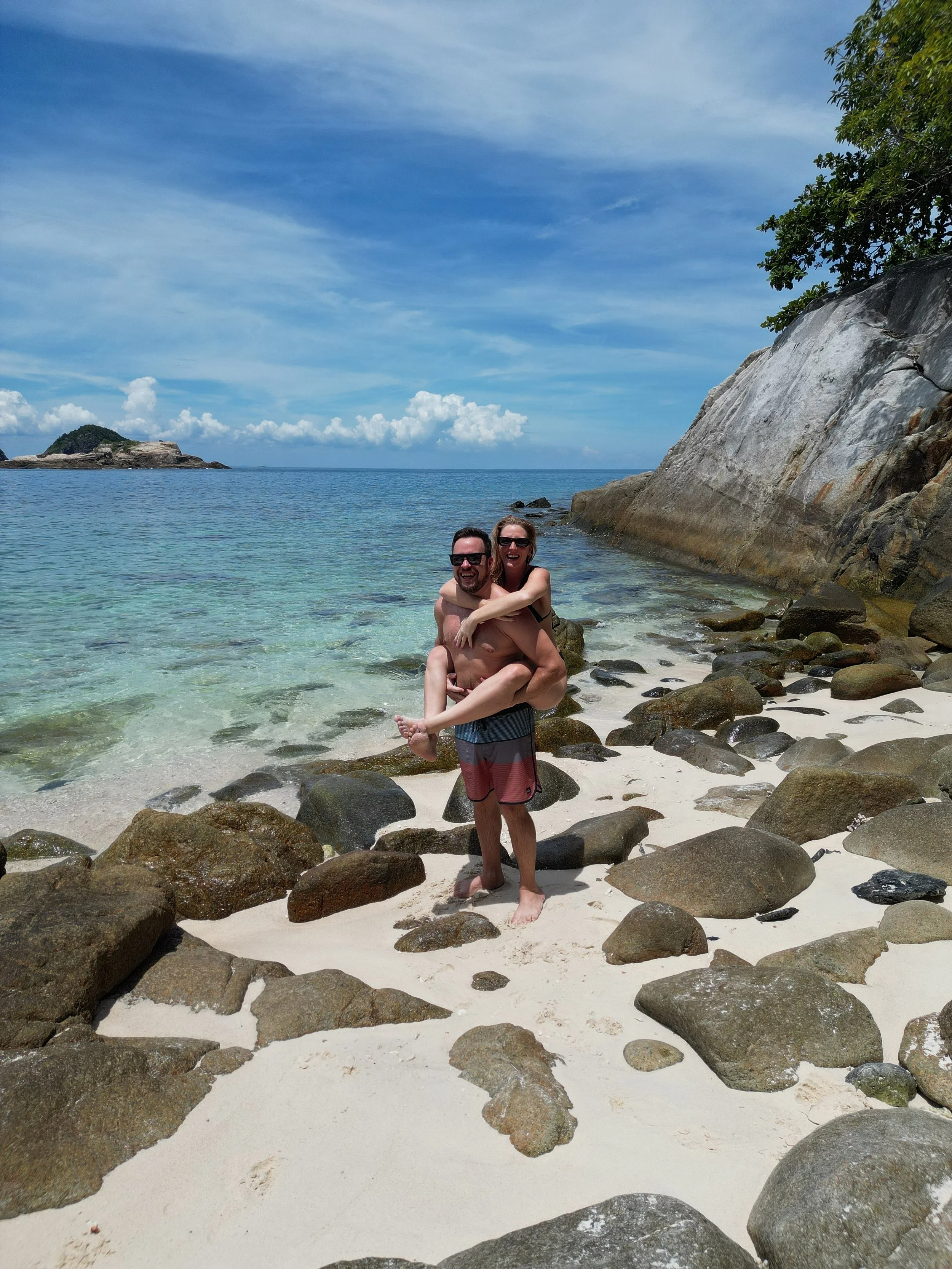
Who we are: We're Marcel and Kathleen, a couple with corporate jobs, one big trip a year and a drone that comes everywhere with us. I (Marcel) plan every route down to the ferry timetable, Kathleen trusts the plan, and everything on this blog is something we did and paid for ourselves. More about us →
Some links in this post are affiliate links. If you book through them, we may earn a small commission at no extra cost to you. We only recommend places and services we've used and paid for ourselves.